
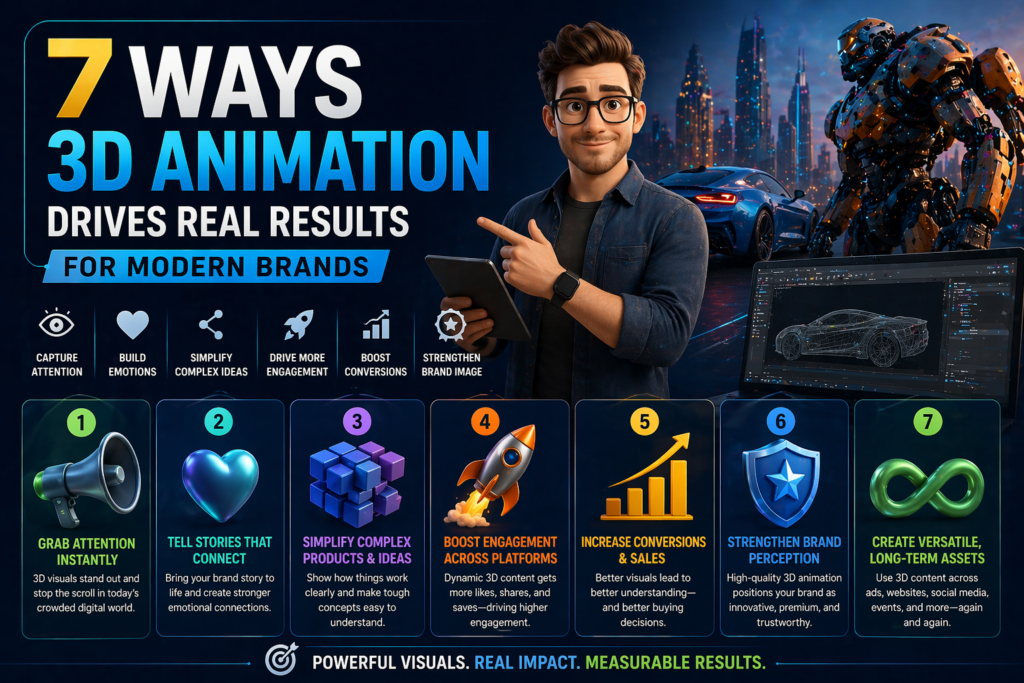
3D Animation US | Published: Wednesday, March 25, 2026 | Target Keyword: 3D animation benefits for business | ~1,650 words
The business case for 3D animation is no longer theoretical. Across industries — from consumer electronics to commercial real estate, from pharmaceutical marketing to e-commerce retail — brands are deploying 3D animation as a front-line marketing asset and reporting measurable returns. Engagement lifts. Conversion improvements. Shortened sales cycles. Reduced product return rates.
Yet many business owners still approach 3D animation as a creative indulgence rather than a commercial instrument. This article addresses that gap directly. Below are seven concrete, evidence-grounded ways that professional 3D animation produces business results — not just impressive visuals.
1. It Stops Attention in a Saturated Content Environment

The average American is exposed to between 4,000 and 10,000 brand messages per day. In that volume of noise, attention is the scarcest commercial resource in existence. 3D animation is one of the most reliably effective tools for capturing it.
The human visual system is hardwired to respond to motion and depth. When a 3D product rotates in a social media feed, or a building materializes in an email header, or a molecule unfolds in a digital ad, the brain registers it as something fundamentally different from everything around it. This is not a subjective observation — it is a neurological reality that modern advertisers exploit deliberately.
Brands using 3D animation in paid social campaigns consistently report higher thumb-stop rates, lower cost-per-click, and better scroll-depth on landing pages. The competitive advantage is real, and it is available to any brand willing to invest in quality production.
| In a feed full of static images and uninspired video content, a well-executed 3D animation is not just noticed — it is remembered. |
2. It Communicates Complex Products With Unprecedented Clarity

Some products are difficult to explain. Medical devices with internal mechanisms. Industrial equipment with intricate assembly sequences. Software platforms with multi-step workflows. Architectural projects that do not yet exist. For these categories, conventional photography and live-action video are structurally inadequate — they can only show what is physically visible.
3D animation has no such limitation. It can move through walls, disassemble components, highlight invisible internal functions, and render microscopic processes at human scale. The result is not just visually compelling — it is cognitively clarifying. Buyers who understand a product more completely make purchase decisions with greater confidence and lower buyer’s remorse.
In B2B contexts especially, where purchase decisions involve multiple stakeholders and extended evaluation periods, content that reduces confusion and accelerates comprehension is directly linked to shorter sales cycles. A well-produced 3D explainer animation does not just market a product — it does part of the sales team’s job.
3. It Elevates Perceived Brand Value

Perception is commercial reality. A brand that consistently produces high-quality visual content is perceived — correctly or not — as a higher-quality brand. This effect is particularly pronounced in categories where consumers cannot easily evaluate product quality before purchase.
A direct-to-consumer brand that deploys photorealistic 3D product animation across its website, ads, and packaging signals capability and investment that a brand using stock photography simply cannot match. This perceived quality premium translates into tangible business outcomes: higher average order values, stronger price tolerance, and greater brand loyalty.
For businesses competing against larger, better-funded competitors, 3D animation is one of the most effective tools for closing the perceived quality gap. It levels the visual playing field in a way that few other content investments can.
4. It Improves E-Commerce Conversion Rates

The e-commerce sector has generated more rigorous data on the commercial impact of 3D animation than almost any other industry — and the results are consistently favorable. Studies across multiple product categories have shown that shoppers who interact with 3D product visualizations — rotating them, zooming in, examining them from multiple angles — are significantly more likely to complete a purchase and significantly less likely to return the product.
The mechanism is intuitive: 3D interaction reduces the uncertainty that drives cart abandonment. When a consumer can examine a product from every angle and understand exactly what they are buying, the risk of disappointment at delivery is materially lower. Returns are expensive — in logistics costs, customer service time, and customer lifetime value. 3D animation addresses this problem at the source.
For e-commerce brands competing in categories with high return rates or significant price points, the ROI calculation on 3D product animation is often straightforward: the conversion lift and return reduction alone can justify the production investment within the first campaign cycle.
| Shoppers who can see a product from every angle before they buy it are more confident buyers — and more confident buyers are better customers. |
5. It Creates Reusable, Multi-Platform Content Assets

One of the most underappreciated financial advantages of 3D animation is the reusability of the underlying assets. When a professional studio builds a 3D model of your product, that model does not expire after one campaign. It can be deployed across an essentially unlimited range of outputs without additional modeling costs.
| Initial 3D Asset | Downstream Applications |
| Photorealistic product model | E-commerce spin viewer, print-resolution renders, AR/VR experience, packaging mockup, digital ad variations |
| Animated product video | Full-length hero video, 6-second social cut, 15-second pre-roll, silent social version, looping GIF |
| Architectural visualization | Still renders for print, animated walkthrough, interactive floor plan, investor presentation, virtual tour |
| Brand character / mascot | Video series, animated social posts, onboarding animation, app icon, merchandise mockup |
This asset reusability fundamentally changes the unit economics of visual content production. Rather than commissioning new photography or video for every campaign, channel, and format, a brand with a well-managed 3D asset library can produce dozens of content variations from a single production investment. For brands that operate across multiple markets or product variants, the efficiency gains are compounding.
6. It Supports Sales Enablement at Every Stage of the Funnel

3D animation is not just a top-of-funnel awareness tool — though it excels in that role. It is equally powerful in the consideration and decision stages of the buyer journey, particularly in B2B and high-ticket consumer categories.
Top of Funnel
Animated ads, social content, and brand films build awareness and establish visual brand identity. 3D animation at this stage prioritizes impact and memorability over information density.
Middle of Funnel
Product explainers, process animations, and feature demonstrations reduce buyer uncertainty and accelerate the evaluation process. For complex B2B products, this stage is where 3D animation delivers its highest ROI — it replaces or supplements sales calls that might otherwise be required to explain the product.
Bottom of Funnel
Comparison animations, case-specific visualizations, and proposal-stage content support the final purchase decision. A well-timed 3D demonstration — delivered as part of a sales proposal or shown during a pitch presentation — can be the differentiating factor that closes a competitive deal.
7. It Scales Alongside Your Brand’s Growth

Perhaps the most strategically significant benefit of 3D animation is that it is not a one-time investment — it is a scalable content infrastructure. Brands that begin with a single product animation and invest in building a 3D asset library find that each subsequent production becomes more efficient: brand assets are already modeled, style guidelines are established, and the studio relationship is calibrated.
As a brand’s product range expands, its market presence grows, or its channel mix evolves, the 3D animation infrastructure grows with it. A startup that commissions its first product animation in Year 1 and manages its assets well will enter Year 3 with a substantial library of visual content that no competitor without that history can easily replicate.
This compounding effect is why the most commercially sophisticated brands do not evaluate 3D animation on a project-by-project basis. They evaluate it as a foundational content investment — one that pays increasing returns over time.
The Business Case in Summary
3D animation drives real results because it operates at the intersection of attention, comprehension, and credibility — the three factors that determine whether a brand’s content produces commercial outcomes. It captures attention that static content loses. It explains what photography cannot show. It communicates quality that generic visuals cannot signal.
The brands seeing the most significant returns from 3D animation are not necessarily the ones with the largest production budgets. They are the ones that approach animation strategically — identifying the specific commercial problems it solves, deploying it at the right moments in the buyer journey, and building content assets that compound in value over time.
3D Animation US partners with businesses across the United States to develop 3D animation strategies that align with specific commercial objectives. Contact our team to schedule a free consultation and explore where 3D animation can deliver the highest return for your brand.