

The choice between 3D and 2D animation is one of the most common decisions businesses face when commissioning animated content — and it is frequently made on the wrong basis. Some brands default to 3D because it sounds more impressive. Others default to 2D because it sounds more accessible. Neither instinct is a sound basis for a production decision that will directly affect how your audience perceives your brand and how effectively your content achieves its commercial objective.
The right choice between 3D and 2D animation is always determined by three factors: what your content needs to communicate, what aesthetic best serves your brand identity, and what your production parameters allow. This guide works through each factor systematically — and ends with a clear decision framework you can apply to your specific situation.
Defining the Terms: What Is 2D vs. 3D Animation?
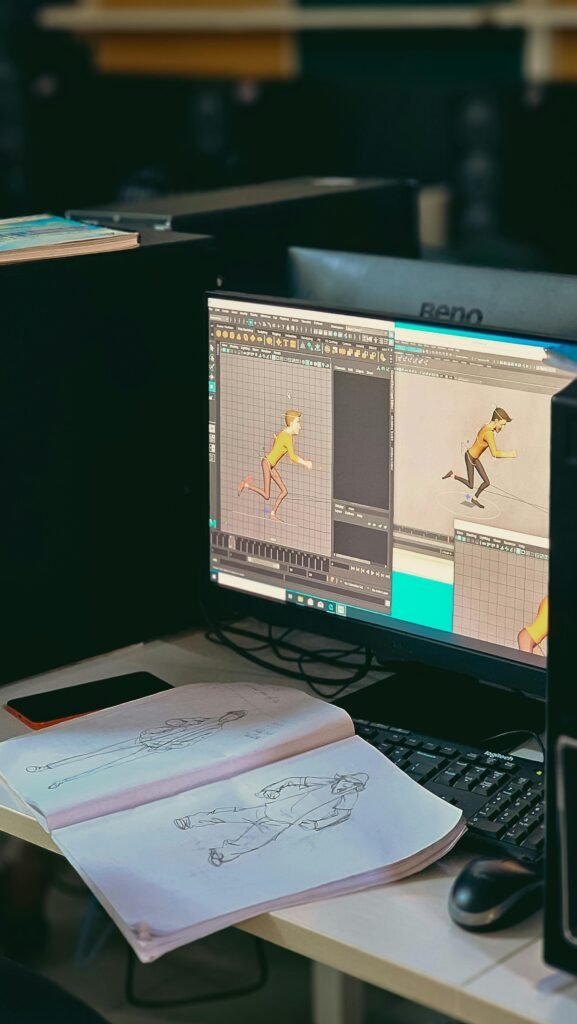
Before comparing them, it helps to be precise about what each term means in a professional production context.
2D Animation is created on a flat, two-dimensional plane. Characters and objects exist in an X/Y space without depth. Traditional hand-drawn animation is 2D, as is digital 2D animation produced in tools like Adobe After Effects, Toon Boom Harmony, and similar applications. Motion graphics — the text, shapes, and graphic elements that animate on-screen in video content — are typically 2D. 2D animation can range from highly simplified flat design to richly illustrated, character-driven work.
3D Animation is created in a three-dimensional digital environment with X, Y, and Z axes — giving objects depth, volume, and the capacity to be viewed from any angle. Objects can be lit with virtual lighting, given surface materials that respond to that lighting, and rendered to produce photorealistic or stylized imagery. 3D animation enables the visual representation of physical reality in a way that 2D cannot.
The Core Differences: A Side-by-Side View
| Factor | 2D Animation | 3D Animation |
| Visual depth | Flat; depth conveyed through illustration technique | True three-dimensional depth; physically accurate perspective |
| Photorealism | Not achievable; stylized by definition | Achievable at high production standard |
| Stylistic range | Extremely wide; from minimal flat design to rich illustration | Wide but bounded; from stylized to photorealistic |
| Product visualization | Limited; cannot show physical product accurately | Optimal; can replace or complement photography |
| Character animation | Excellent for stylized characters; limited realism | Full range; from stylized to photorealistic performance |
| Complex mechanisms | Difficult to depict with accuracy | Highly capable; can render internal mechanics and assemblies |
| Production cost | Generally lower for equivalent duration | Generally higher; reflects additional production complexity |
| Production timeline | Typically shorter | Typically longer; modeling and rendering add time |
| Asset reusability | Moderate; scene reuse possible but limited by angle | High; 3D models reusable across unlimited outputs and angles |
| Brand consistency | Dependent on illustration consistency | High; 3D assets are parametric and exactly reproducible |
When 2D Animation Is the Right Choice

There is a persistent misconception that 3D animation is inherently superior to 2D, and that choosing 2D represents a compromise. This is wrong. For a significant range of business applications, 2D animation is not only sufficient — it is the better production choice. Here is when to choose it.
When Your Brand Aesthetic Is Illustrative or Graphic
If your brand identity is built around illustration, flat design, or a graphic visual language, 2D animation is the natural extension of that identity. Forcing a 3D production onto a fundamentally 2D brand can produce visual dissonance — the animation looks incongruous with everything else in the brand ecosystem. For brands like these, 2D animation preserves visual consistency and typically produces a more cohesive result.
When You Are Explaining an Abstract Concept
Many explainer videos — particularly for SaaS products, financial services, and professional services — deal in abstract concepts: workflows, data flows, organizational structures, economic mechanisms. These abstractions do not exist in physical space and therefore gain nothing from 3D rendering. A well-designed 2D motion graphic or character-driven 2D explainer communicates these concepts more efficiently and often more clearly than a 3D equivalent would.
When Budget and Timeline Are Constrained
For equivalent duration and complexity, a 2D animation is generally less expensive and faster to produce than a 3D equivalent. If your project has a tight deadline or a modest budget, and the content does not specifically require 3D’s capabilities, 2D is the commercially rational choice. Choosing 3D in this context often produces a compromised 3D result — a production that lacks the quality to justify the format — rather than an excellent 2D result that fully delivers on the brief.
When You Need a Long-Form Series
Producing an animated series — a library of explainer videos, a multi-episode branded content series, or a collection of training modules — often favors 2D production economics. The character and asset setup costs are lower, iteration is faster, and the production pipeline can accommodate high volume more efficiently. Many of the most successful branded content series are produced in 2D for exactly this reason.
| The best animation format for your brand is the one that most efficiently achieves your communication objective within your production parameters — not the one that sounds more impressive in a brief. |
When 3D Animation Is the Right Choice

3D animation is the definitive choice — and often the only viable choice — in the following situations.
When You Need to Show a Physical Product
3D animation is the only format capable of depicting a physical product with photographic accuracy from any angle, in any environment, in any lighting condition, before the product has been manufactured. For product launches, e-commerce visualization, packaging campaigns, and advertising where the product itself is the hero of the creative, 3D animation is the standard. 2D animation cannot serve this function with any meaningful degree of realism.
When You Need to Show the Invisible
Internal mechanisms, molecular structures, subsurface biological processes, underground infrastructure, the inside of a sealed industrial component — none of these can be filmed. 3D animation can render all of them with complete visual accuracy and creative control. This capability is the reason 3D animation is the standard format for medical and scientific visualization, industrial training content, and engineering communication.
When You Are Building Premium Brand Perception
A photorealistic 3D brand film signals a level of production investment and brand ambition that 2D animation cannot. For brands competing in premium or luxury market segments — or for enterprise companies where first impressions with sophisticated buyers carry significant weight — the quality signal embedded in a cinematic 3D production has genuine commercial value. The aesthetic of 3D, at high production standard, says something about the brand that 2D cannot say.
When You Need Architectural or Spatial Content
Architectural visualization, interior design presentation, real estate marketing, and any content that needs to place the viewer inside a space requires 3D. There is no 2D equivalent for a photorealistic walkthrough of a building that does not yet exist. This is one of 3D animation’s most commercially valuable exclusive capabilities.
When Asset Reuse Across Multiple Campaigns Is a Priority
A professionally built 3D product model can be used to produce a launch video, a 360-degree spin for e-commerce, an AR experience, a print-resolution still for packaging, a social media ad cut-down, and a trade show display — all from the same underlying asset. 2D animation does not offer this level of asset portability. For brands managing high-volume visual content production across multiple channels, the 3D asset infrastructure pays compounding dividends.
The Hybrid Approach: Getting the Best of Both

Many of the most effective brand animation productions combine 2D and 3D elements deliberately. A 3D product visualization composited over a 2D animated environment. A 3D character placed in a flat, graphic brand world. Animated motion graphics overlaid on photorealistic 3D renders. This hybrid approach allows brands to deploy 3D’s unique capabilities precisely where they are needed while maintaining the stylistic range and cost efficiency of 2D where 3D’s specific advantages are not required.
The hybrid approach is also common in explainer animation: a 3D product model appears at the moments when the physical product needs to be seen accurately, while the surrounding explanatory animation uses simpler 2D motion graphics. This gives the production the visual authority of 3D where it matters most, without the cost and timeline of a fully 3D production.
The Decision Framework
Apply the following questions to your specific project to determine which format is right.
- Does your content need to show a physical product realistically? If yes, 3D is required.
- Does your content need to depict something invisible, internal, or spatial? If yes, 3D is required.
- Is your brand’s visual identity illustrative or graphic? If yes, 2D is likely better aligned.
- Is your content primarily about explaining an abstract concept? If yes, 2D or hybrid may be more efficient.
- Do you need to reuse assets across multiple campaigns and formats? If yes, 3D’s asset infrastructure advantage is significant.
- Is premium brand perception a primary objective? If yes, high-quality 3D makes a stronger quality signal.
- Are budget and timeline the binding constraints? If yes, 2D typically offers more output per dollar.
Choosing the Format That Serves the Brief
The most common mistake in the 3D vs. 2D decision is treating it as a prestige question rather than a production question. 3D is not inherently better. 2D is not inherently cheaper in all contexts. Both are legitimate, professional formats — and both are capable of producing outstanding work when matched correctly to the brief they are serving.
The businesses that make this decision well are those that start with a clearly defined objective and a thorough understanding of what their content needs to communicate. The format follows from the brief — not the other way around.
3D Animation US produces both 3D and hybrid animation for businesses across the United States. If you are working through the format decision for an upcoming project and would like a professional perspective, contact our team for a no-obligation consultation. We will help you identify the approach that best serves your specific brief.