
3D Animation US | Published: Monday, April 14, 2026 | Keyword: 3D explainer video for B2B | ~1,700 words
B2B lead generation has a comprehension problem. The products and services that B2B companies sell are often complex — multi-component systems, technical platforms, service methodologies, industrial equipment, scientific instruments — and the marketing content that represents them frequently fails to communicate their core value clearly enough to convert informed interest into a qualified lead.
This is not a messaging problem. Most B2B brands have reasonably clear messaging. It is a communication format problem: the formats most commonly used to communicate B2B product value — written copy, static diagrams, screenshots, slideware — are structurally inadequate for communicating complexity to audiences that process visual information faster and more deeply than written information.
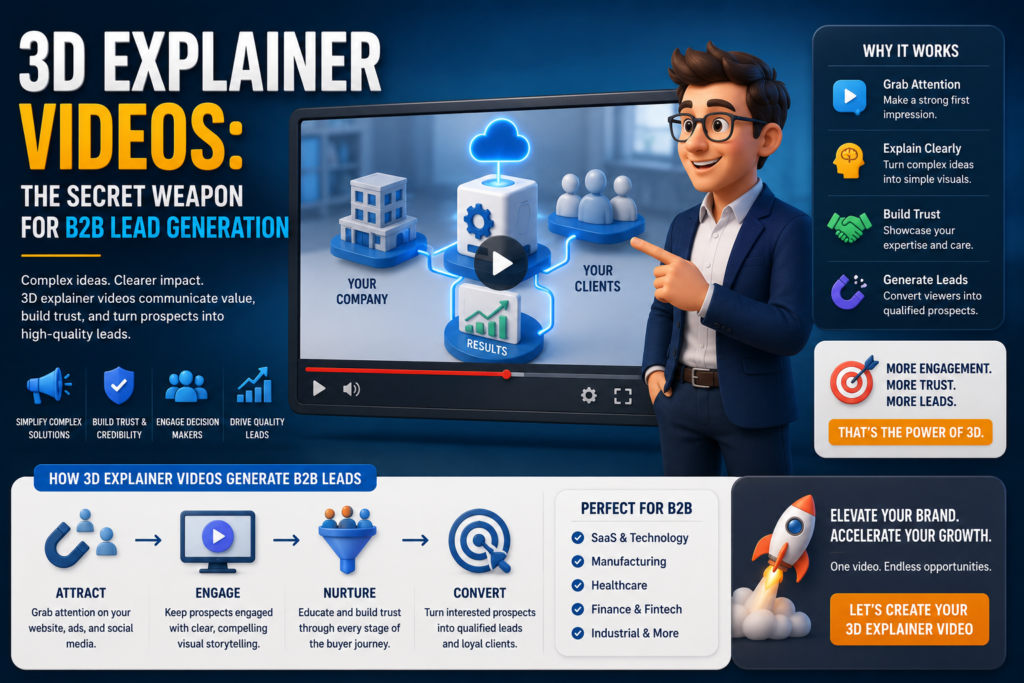
A 3D animated explainer video solves this problem directly. It translates complexity into a visual narrative that a buyer can follow without prior technical knowledge, communicate to internal stakeholders without specialist interpretation, and share across a buying committee in a format that requires no explaining of its own. This article makes the case for 3D explainer videos as a B2B lead generation asset — and explains how to deploy them for maximum commercial impact.
Why B2B Buying Is a Visual Problem

The B2B buying process typically involves multiple stakeholders across different functions — technical evaluators, commercial decision-makers, procurement leads, and executive sponsors — each with different levels of technical knowledge, different evaluation criteria, and different questions they need answered before approving a purchase.
The challenge for B2B marketers is that a written or text-heavy explanation of a complex product requires each of these stakeholders to read, interpret, and re-translate the content through their own frame of reference. Technical specifications mean different things to an engineer and a CFO. Feature lists require domain knowledge to evaluate. The burden of comprehension falls entirely on the reader — and in a buying process that already demands significant time and cognitive effort from committee members, this burden is a friction source that delays decisions and generates drop-off.
A 3D animated explainer reduces this friction materially. It presents the product’s core value proposition visually — showing what it does, how it works, and what the buyer’s situation looks like after they use it — in a format that is equally accessible to the technical evaluator and the executive sponsor. It standardizes the buyer’s comprehension of the product across the entire committee. And it does all of this in 60–120 seconds, a fraction of the time required to read the equivalent information.
| In B2B sales, the first person who can make the complex simple usually wins the deal. A 3D explainer video is the most efficient tool for achieving that simplicity at scale — across every buyer, every channel, and every stage of the funnel simultaneously. |
Where 3D Explainer Videos Fit in the B2B Funnel

Top of Funnel: Earning Qualified Attention
At the top of the B2B funnel, the challenge is not awareness — it is relevance. A potential buyer who encounters your brand needs to understand within seconds whether what you do is relevant to a problem they actually have. A 3D animated explainer deployed as a content marketing asset — on a landing page, in a LinkedIn post, in a targeted display campaign — can communicate your product’s core value proposition with enough clarity and visual impact to earn the qualified attention of a buyer who would otherwise have scrolled past.
The visual nature of 3D animation is particularly effective at this stage because it does not require the buyer to already be engaged enough to read a white paper or attend a webinar. It works passively — capturing attention through motion and depth and communicating value through visual demonstration before the buyer has consciously committed to evaluating your product.
Middle of Funnel: Converting Interest Into Engagement
The middle of the B2B funnel is where comprehension is most commercially critical. A buyer who understands your product well enough to engage with a sales process is worth exponentially more than one who understands it vaguely enough to have downloaded a gated asset. 3D explainer videos placed at middle-funnel touchpoints — on product pages, in email nurture sequences, as follow-up content after a discovery call — accelerate this comprehension and shorten the path from interest to qualified engagement.
The most effective middle-funnel deployment is the product page explainer: a 90–120 second 3D animation that explains the product’s core mechanism, its key differentiator, and the specific problem it solves — placed prominently on the product detail page and accompanied by a direct call to action for a demo or consultation. Visitors who watch this video before requesting a demo arrive at the demo with a baseline understanding of the product that significantly improves the quality and efficiency of the sales conversation.
Bottom of Funnel: Supporting the Decision
At the bottom of the B2B funnel, where a buying committee is evaluating your product against alternatives, the explainer video serves a different function: it is a leave-behind that works after the sales conversation ends. A buyer who receives a proposal with an embedded 3D animation demonstrating exactly what the product would do in their specific use case has a reference asset that no competitor’s static proposal can match. For enterprise deals with extended evaluation periods and multiple decision-makers, the quality and clarity of this asset is a meaningful differentiator.
The ROI Calculation for B2B 3D Explainer Videos
The commercial case for a 3D explainer video investment is most clearly made through the lens of sales efficiency — specifically, the time cost of the sales process that the video replaces or accelerates.
| Sales Process Impact | Conservative Scenario |
| Discovery calls eliminated by video pre-qualification | If 20% of leads who watch the explainer self-qualify or self-disqualify before contacting sales, and the company handles 50 discovery calls per month at 45 minutes each, the video saves 7–8 hours of sales time per month |
| Discovery call quality improvement | Leads who have watched the explainer arrive with product comprehension that allows the call to skip the explanation phase — improving conversion rate from discovery to next step by 15–30% |
| Sales cycle compression | Buying committees that circulate the explainer internally instead of relying on secondhand communication from one evaluator reach consensus faster — reducing average deal cycle length |
| Proposal conversion uplift | Proposals featuring embedded 3D animation convert at higher rates than text-only proposals across B2B categories — a 10–20% conversion uplift on a modest deal volume generates significant incremental revenue |
| Content asset life | A well-produced 3D explainer has a useful life of 2–4 years before the product or brand positioning requires an update — amortizing the production investment over a substantial period |
Anatomy of an Effective B2B 3D Explainer

B2B explainer videos have a different structural logic from consumer-facing animation. The audience is more sophisticated, the decision is higher-stakes, and the content must simultaneously satisfy technical evaluators and executive decision-makers. The following structure is calibrated to these requirements.
Open With the Problem — Specifically
Name the specific operational, technical, or commercial problem your product addresses. Not a generic challenge that any company in your space claims to solve — the specific friction point that your best customers describe as their reason for buying. Buyers who hear their actual problem named precisely in the first 15 seconds of a video are significantly more likely to continue watching.
Introduce the Solution Mechanism — Visually
Show how your product addresses the problem using 3D animation’s unique visual capabilities. If it is a physical product, show how it works — the mechanism, the assembly, the internal process. If it is a software platform, visualize the workflow it enables. If it is a service, represent the methodology as a visual process. The goal is to make the solution concrete and comprehensible without requiring the viewer to already understand the technical domain.
Quantify the Outcome
B2B buyers are accountable for the decisions they make. A 3D explainer that communicates the business outcome of using your product — reduced cost, accelerated timeline, improved reliability, eliminated risk — gives the buyer the language they need to justify the purchase internally. Include at least one concrete outcome claim, supported by data or customer evidence where possible.
Close With a Specific Next Step
End with one clear action: schedule a demo, request a pilot, contact the team, download the technical specification. B2B buyers who have been convinced by an explainer video want a frictionless path to the next step. Make that path obvious and singular.
Production Considerations Specific to B2B
B2B 3D explainer videos have production requirements that differ from consumer-facing animation. These should be addressed in the brief.
- Technical accuracy is non-negotiable: For products with specific technical mechanisms, the animation must be accurate. A viewer who is a domain expert will immediately identify inaccuracies that undermine credibility. Involve your technical team in the review process.
- Tone: authoritative, not hyperbolic: B2B buyers are allergic to marketing language. The voiceover and on-screen text should be precise and evidence-based, not aspirational and unsubstantiated.
- Duration discipline: 60–90 seconds for top-of-funnel awareness content; 90–120 seconds for mid-funnel product explanation; up to 180 seconds for bottom-funnel technical deep-dives. Longer is only justified by genuine informational depth, not by the desire to include more features.
- Multiple format versions: Produce a full-length version for the product page, a 30-second cut for paid advertising, and a 60-second version for email campaigns. These derivative formats extend the commercial reach of a single production investment.
3D Animation Is the Right Tool for This Job
The reason 3D animation specifically — rather than 2D motion graphics, live-action, or screencast video — is the right format for most B2B explainer work comes down to the nature of what B2B products typically need to communicate. Complex physical mechanisms. Abstract technical processes. Multi-stakeholder workflows. System integrations. Scientific phenomena. All of these are better served by 3D animation’s ability to make the invisible visible, the complex clear, and the abstract concrete.
For B2B companies whose products have genuine value that their current content fails to communicate clearly, a well-produced 3D explainer video is not a marketing expense. It is a sales infrastructure investment — one that works continuously, across every channel and every buyer touchpoint, producing qualified lead flow that the sales team can close.
3D Animation US produces B2B 3D explainer videos for companies across the United States — from technology platforms to industrial equipment to professional services. Contact our team to discuss your product and brief.